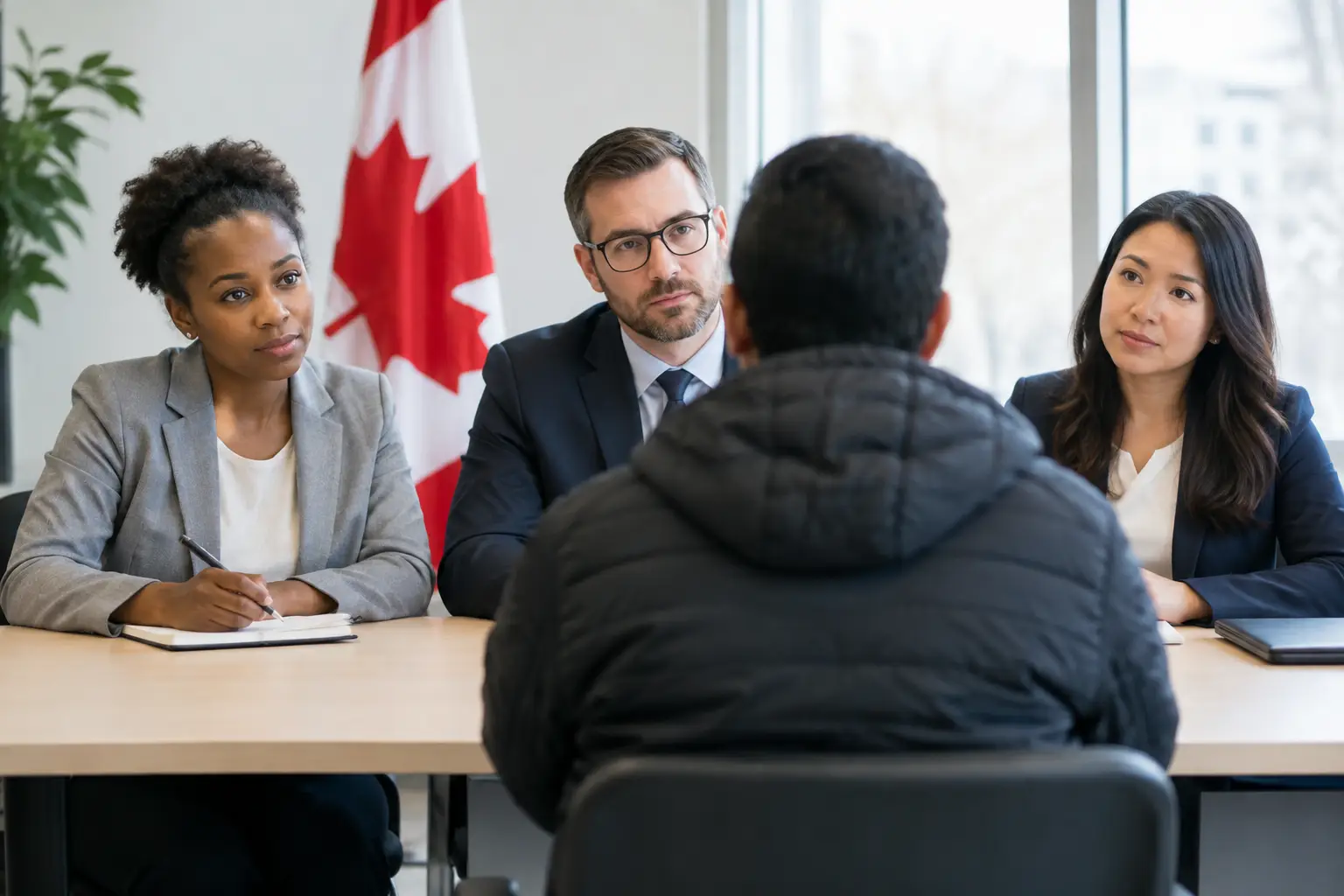
A refugee claim can carry the weight of an entire family’s future. If you have been referred to the Refugee Protection Division, or RPD, you may be asking: refugee hearing in Canada: what happens at the RPD? The short answer is that an independent decision-maker will hear your story, review your evidence, and decide whether Canada should recognize you as a Convention refugee or a person in need of protection.
The hearing is not meant to be a test of perfect speaking or paperwork. It is, however, a legal proceeding. Careful preparation matters because the RPD member must assess whether your account is credible, whether you face a serious risk if returned to your country, and whether protection may be available elsewhere in your home country.
What the RPD Does in a Refugee Hearing in Canada
The RPD is a division of the Immigration and Refugee Board of Canada. It decides refugee protection claims made from within Canada. Its role is different from that of Immigration, Refugees and Citizenship Canada or the Canada Border Services Agency. The RPD does not decide whether you qualify for a work permit, study permit, or permanent residence through an economic program. It decides whether you need refugee protection.
To succeed, a claimant generally needs to show either a well-founded fear of persecution because of race, religion, nationality, political opinion, or membership in a particular social group, or a personalized risk of torture, a risk to life, or cruel and unusual treatment or punishment if returned.
Every claim is decided on its own facts. A difficult situation in a country may provide important context, but the RPD also needs to understand your personal circumstances. Why are you at risk? Who presents the risk? What happened to you? Why can you not safely return or obtain effective state protection?
Before the Hearing: Building the Record
Much of a refugee claim is shaped before the hearing date. Your Basis of Claim form, commonly called the BOC form, is central to the process. It sets out your identity, family details, travel history, fear of return, and the events behind your claim.
The details in the BOC form should be truthful, complete, and consistent with your evidence. That does not mean a person must remember every date perfectly, particularly after trauma, fear, displacement, or years of uncertainty. It does mean that important discrepancies should be identified and explained honestly rather than ignored.
You may also submit documents that support your claim. Depending on the facts, these can include identity records, police reports, court documents, medical or psychological reports, threatening messages, photos, proof of political or community activity, affidavits from witnesses, and country-condition materials. Documents must be relevant, readable, and presented according to the RPD’s procedural requirements.
Deadlines matter. The notice of hearing and RPD rules set out when evidence must be filed. In many cases, claimants must provide documents they intend to rely on at least 10 days before the hearing, but procedural timelines can vary. Waiting until the last minute can create avoidable problems, especially if documents need to be translated or if new evidence needs a clear explanation.
Documents not written in English or French generally require a translation and a translator’s declaration. Original documents should be kept safely. The RPD may ask to see them, and the member may question whether a document is reliable, complete, or connected to your case.
Who Will Be at the Hearing?
A hearing is usually private. The people present may include you, the RPD member who decides the claim, an interpreter if needed, your counsel or authorized representative, and sometimes a Minister’s representative. A Minister’s representative may participate when the government has concerns about issues such as identity, credibility, exclusion, criminality, or security.
If a claimant is a child or cannot fully understand the process, the RPD may appoint a designated representative. That person helps protect the claimant’s interests during the proceedings. This role is important, but it is not the same as being a legal representative.
Hearings may take place in person or by videoconference, depending on the circumstances and the RPD’s directions. If you need interpretation, accommodation for a disability, or another procedural support, raise it as early as possible. Clear communication is essential. You should not guess at a question you do not understand.
What Happens During the RPD Hearing?
The member will usually begin by confirming identities, explaining the process, and ensuring everyone can hear and understand the proceedings. You will be asked to promise that your testimony will be truthful.
The member may then ask questions about your BOC form, evidence, and reasons for claiming protection. The questions can be detailed. You may be asked about dates, places, people involved, attempts to seek protection, internal relocation within your country, your travel route, or why a document was obtained at a particular time.
Some questions may feel repetitive or difficult. That does not automatically mean the member has decided against you. The member has a duty to clarify the evidence and test the claim. Your job is to listen carefully, answer the question asked, and say when you do not know or cannot remember. Do not invent details to fill a gap.
If you have counsel, they may ask follow-up questions to clarify important evidence after the member has finished. If a Minister’s representative is involved, they may also question you. Counsel may make final submissions explaining how the evidence meets the legal test for refugee protection.
A strong hearing is not about delivering a memorized speech. In fact, memorized answers can sound unnatural and make it harder to respond when a question is asked in a different way. Preparation should help you understand your own documents, organize the timeline, anticipate sensitive issues, and tell the truth clearly.
Issues the RPD May Examine Closely
The specific concerns depend on the claim, but several issues arise often. Identity is fundamental because the RPD needs to know who you are and your country of nationality. If you have limited identity documents, you may need to explain why and provide alternative evidence where possible.
Credibility is another common issue. The member may compare your oral testimony with your BOC form, immigration records, prior visa applications, social media, travel documents, and supporting letters. A difference does not necessarily end a claim. But an unexplained difference on a central fact can affect the decision.
The RPD may also consider state protection. If the feared harm comes from a private individual or group, the question may be whether authorities in your country can provide adequate protection. Internal flight alternative may also arise: could you safely and reasonably live in another part of your country? These questions are fact-specific. A theoretical option is not always a realistic or safe one.
When Will You Receive a Decision?
Sometimes the member gives an oral decision at the end of the hearing. In other cases, the member reserves the decision and sends written reasons later. A positive decision recognizes you as a Convention refugee or a person in need of protection. You may then be able to apply for permanent residence as a protected person, subject to the applicable requirements.
If the claim is refused, do not assume there are no next steps. Some claimants may appeal to the Refugee Appeal Division, while others may need to consider an application for judicial review at the Federal Court. Not every claimant has access to the same appeal options, and strict deadlines can apply. A refusal may also have removal consequences, so seeking qualified advice quickly is essential.
How to Prepare Without Losing Your Voice
The best preparation is structured and honest. Review your BOC form and evidence carefully. Create a timeline of significant events. Identify documents that need translation or clarification. Discuss any prior visa applications, border interviews, travel history, or facts that may appear inconsistent in the record.
It is also wise to prepare for the practical side of the hearing. Arrange child care if needed, test your technology for a virtual hearing, have water nearby, and allow enough time to arrive or log in. If emotional distress, trauma, or a health condition affects your ability to testify, supporting professional evidence and an early request for accommodation may be appropriate.
You do not have to figure out a refugee claim alone. Authorized representation can help you prepare the record, understand the legal issues, meet procedural deadlines, and approach the hearing with a clear strategy. At Novica Immigration, the focus is on honest guidance and careful preparation, not promises about an outcome.
Your hearing is a serious moment, but it is also your opportunity to be heard. Give yourself time to prepare, ask for help when the process is unclear, and make sure the RPD receives a complete and truthful picture of why returning is not safe for you.